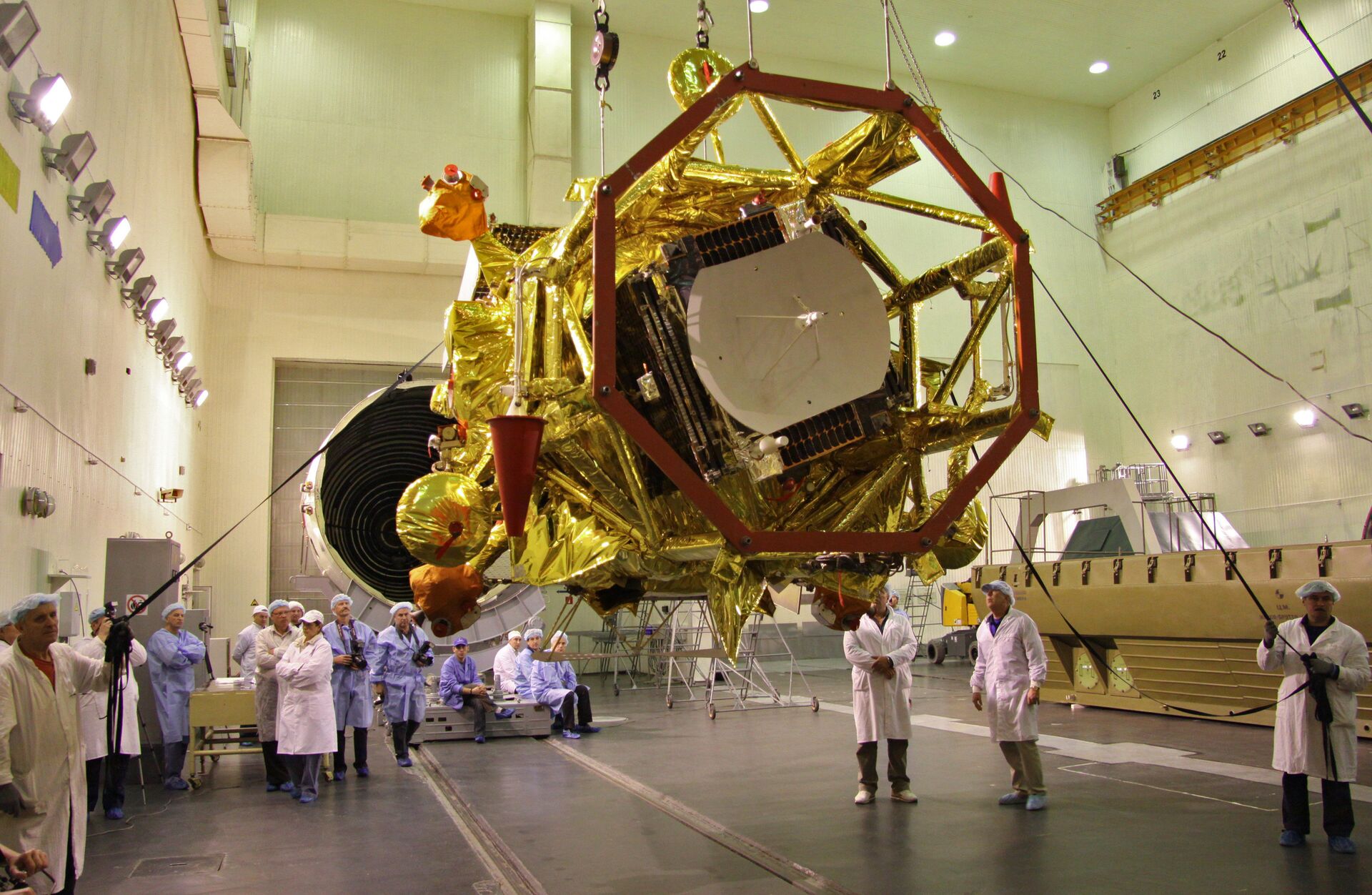
Russia has time until the beginning of December to establish contact with its Phobos-Grunt unmanned spacecraft that is stranded at a low-Earth orbit after launch, the Russian space agency Roscosmos said on Monday.
The Mars probe was launched from the Baikonur Space Center in Kazakhstan on Wednesday, but its engines failed to put it on course for the Red Planet. The craft, designed to bring back rock and soil samples from the Martian moon Phobos, is currently moving along a so-called support orbit.
All attempts to receive a signal from the spacecraft have so far been unsuccessful.
“We estimate that the Phobos-Grunt will fly until January, and to make it perform its mission we still have time until the beginning of December,” head of Roscosmos Vladimir Popovkin told reporters.
Popovkin said the probe is moving along a 200-km orbit and has “communication windows” with ground control stations for about 2 minutes at a time.
In order to establish communications with Phobos-Grunt, the specialists reduced the power of the signal sent to the probe, since the first contact with the spacecraft was originally planned at a much higher trajectory, and widened the “communication window.”
Popovkin dismissed concerns that the remains of the probe could hit a populated area on Earth after the spacecraft enters the planet’s atmosphere in the worst case scenario.
“There are 7.5 metric tons of fuel in the aluminum tanks on board. We have no doubts that they will explode [and destroy the probe] upon re-entry,” Popovkin said. “It is highly unlikely that its parts would reach Earth.”
The head of Roscosmos said the potential loss of the Mars probe would not affect the pace of Russia’s space exploration.
“It would be a disappointment, of course, but it does not mean that we will fold our scientific projects,” Popovkin said.
“As to Mars – it is a planet that does not like earthlings. Only 30 percent of Soviet-Russian launches to Mars were successful, the Americans have had 50 percent success, while all attempts by Japan and Europe have failed so far,” the official said.
According to NASA, though, Russia has failed all 17 attempts to study the Red Planet since 1960.
The most recent failure occurred in 1996, when Russia lost its Mars-96 orbiter during the launch.