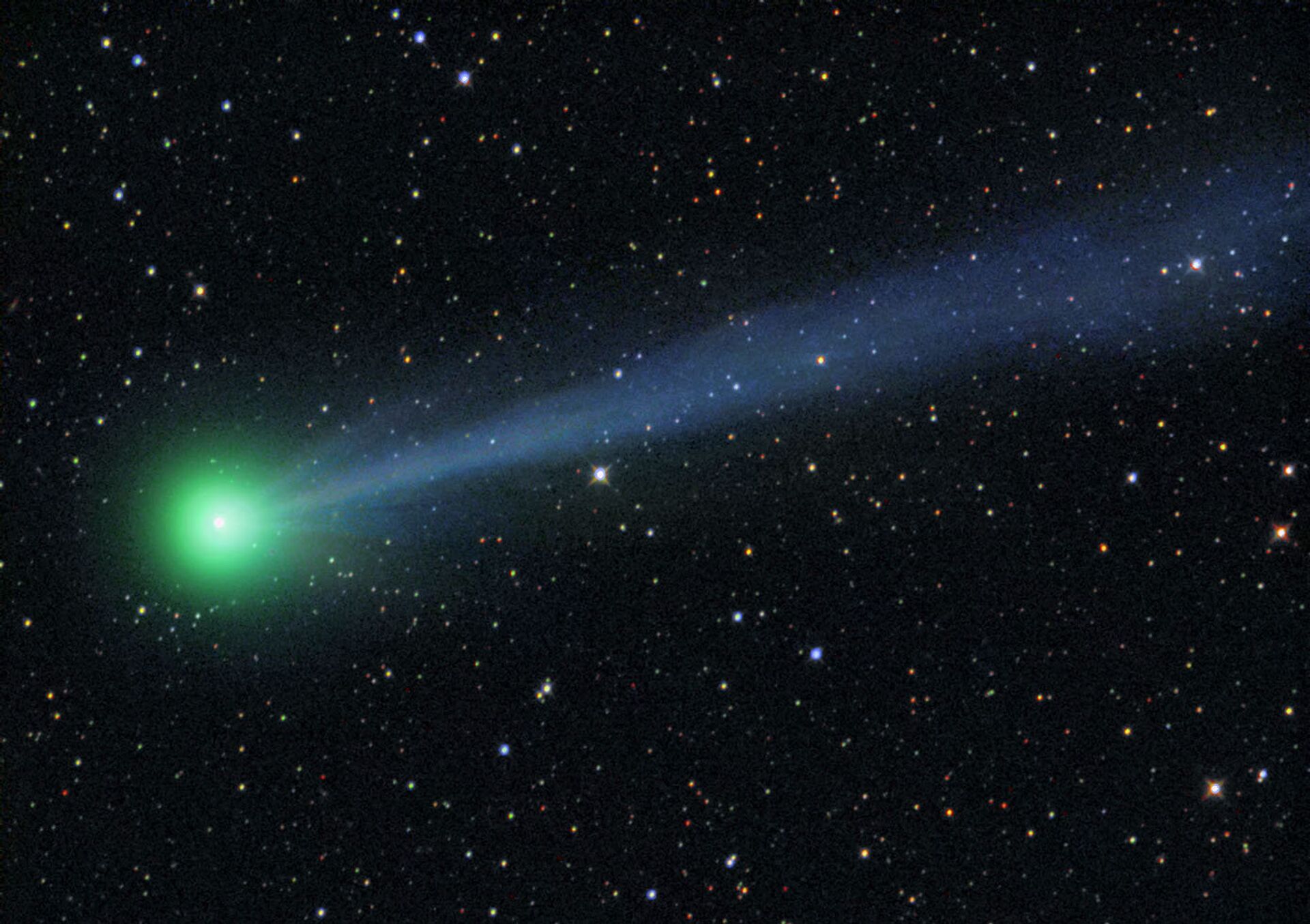
The C/2009 R1 McNaught comet passed the Earth on Wednesday at the closest proximity of 170 million kilometers and continues moving toward the Sun, a Russian astronomer said.
"The comet passed the closest point [to the Earth] early on June 16 at a distance of 169.8 million kilometers," said Sergei Barabanov, head of the Zvenigorod observatory in the Moscow Region.
The comet, discovered in 2009 by well-known British-Australian astronomer and "comet-catcher" Robert H. McNaught, will pass the Sun at its closest proximity of 60.5 million kilometers on July 2.
The comet's green plasma head, or coma, is larger than the planet Jupiter, while the long willowy ion tail stretches more than a million kilometers through space.
Barabanov said the brightness of the comet would increase as it nears the Sun but it could be viewed only through powerful binoculars or a telescope in the morning sky.
The C/2009 R1 is expected to eventually reach the brightness as high as magnitude 2 from June 30 to July 2.
"The comet is moving along a hyperbolic orbit and will leave the Solar system for hundreds of years after it turns around the Sun," the astronomer added.
MOSCOW, June 17 (RIA Novosti)